
Highlands County Court Records After a Jail Arrest
After a Highlands County arrest, the path runs in steps. The sheriff or a city police agency books the person into the jail. The roster then shows the booking charges and a bond figure. Those charges are not final. The State Attorney for the Tenth Judicial Circuit reviews the case and decides what to file in court. When the prosecutor files, a case opens, and that case file is the court record kept by the Highlands County Clerk of Circuit Court and Comptroller.
It helps to keep the two sides apart. For the booking and custody side, the jail inmate records page covers the roster, and the jail mugshots page covers booking photos. This page is about the court record that follows the arrest: the charges a prosecutor filed and how the case moves through the court. Both come from the same arrest, but they live in different systems.
How to Find Highlands County Court Records After an Arrest
Court charges and case activity are searched through the clerk's online court records system. The clerk runs a public portal where you can look up a case by a person's name or by a case number. The booking detail stays on the jail roster, but the filed charges, hearings, and rulings live in the court file.
- Open the Highlands County online court records search and choose Public access.
- Click I Agree on the disclaimer to continue.
- Search by last name, or by case year, court type, and sequence number.
- Open the case and read the charge list, the status of each charge, and the docket events.
The clerk warns that the online information is a public service, is not the official court record, and may change without notice. For a certified copy or the official file, contact the clerk's office directly.
The clerk's court records landing page explains the search options and the disclaimer you must accept first. The clerk court records search page is the official entry point.
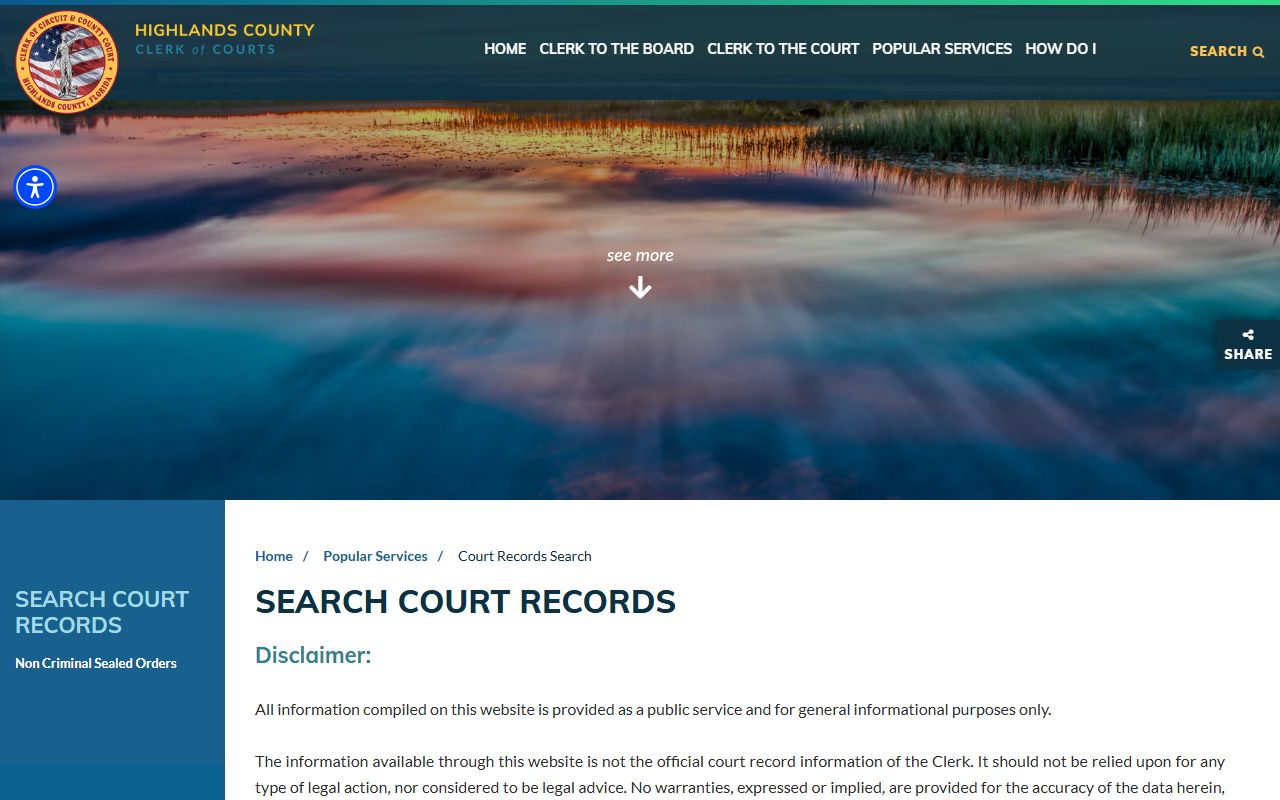
From that page, the public link opens the Civitek search where the name and case fields below appear.
Court Case Search Fields
The public court search offers both a person search and a case search. The person search needs a last name or a business name, and you can narrow it with a first name, a filing date range, a date of birth, or a court type. The case search needs the year, the court type, and a sequence number. The table lists the main fields.
| Field Label | Type | Required | Notes |
|---|---|---|---|
| Access type | Button | Yes | Public, Attorney, Registered User, or Party Access. |
| Last Name | Text | Yes or Business Name | Person search needs a last name or a business name. |
| First Name / MI | Text | No | Narrows the party search. |
| Date Case Filed | Date range | No | From and to, in MM/DD/YYYY. |
| Date of Birth | Date | No | MM/DD/YYYY. |
| Case Year / Court Type / Sequence # | Text and dropdown | Yes for case search | Used together to pull one case. |
How Charges Get Filed After an Arrest
The court record begins with a charging document. Booking happens at the jail first, then the charge record starts when the prosecutor files. There are three main types. A complaint is common for misdemeanors, an information is filed by the prosecutor for many felonies, and an indictment comes from a grand jury for the most serious felonies. Each one opens the case in court.
| Complaint | Information | Indictment | |
|---|---|---|---|
| Filed By | Officer / Prosecutor | Prosecutor (State Attorney) | Grand Jury |
| Common For | Misdemeanors | Many felonies | Serious felonies |
| Starts | The case | The case | The case |
In Florida, the State Attorney for the Tenth Judicial Circuit handles this for Highlands County, a circuit that also covers Hardee and Polk Counties. The office reviews the arrest, then decides what to file. It can file an information, amend the charges, reduce them, or decline to file at all. Because of this review, the booking charges on the jail roster are best read as a starting point, not the final word on what a person faces in court.
Charge Status and What It Means
Charges change as a case moves. A booking charge on the jail roster can become a different filed charge, or no charge at all. The prosecutor may amend, reduce, add, or drop counts. The court file shows the current status of each charge. The terms below come up often.
| Status | What It Means |
|---|---|
| Pending | The charge is filed and the case is still moving through the court. |
| Amended / Reduced | The prosecutor changed the charge, often to a lesser offense. |
| Dismissed | The court ended the charge without a conviction. |
| Nolle Prosequi | The prosecutor chose to drop the charge. |
Note: the booking charge you see on the jail roster is the arrest charge, so it can read differently from the charge the prosecutor finally files in court.
Bond and Release After an Arrest
Bond may first show as a number on the jail roster, but the court sets the real terms. A judge reviews custody and bond at first appearance, an early hearing held soon after booking. Bond can be posted in cash, through a licensed bail agent as a surety bond, or waived on personal recognizance. A no-bond hold means release by bond is not available, often due to a court order or a detainer from another agency.
| Bond Type | How It Works |
|---|---|
| Cash Bond | Paid directly to the clerk or jail under the local process. |
| Surety Bond | Posted through a licensed bail bond agent for a fee. |
| PR / Own Recognizance | Release on a written promise to return, with no money bond. |
| No-Bond Hold | Release by bond is not set; a court hold or detainer may apply. |
Warrants That Lead to an Arrest
Many arrests start with a warrant. The clerk's criminal court division issues arrest capiases by order of the court, and a court-record search can show capias and warrant events in the docket when they are public. The sheriff also keeps a warrants unit, though the official page did not expose a public searchable warrant database. If a warrant led to a booking, the person shows on the jail roster.
Do not rely on a web docket alone to decide if a warrant is active. Warrant status can change after an arrest, a bond, a recall, or service by an agency. Confirm with the sheriff, the clerk, or an attorney. The clerk maintains the dockets and judgments, so a court-record search may show capias entries when they are public, while the sheriff's lines confirm whether a warrant is still active.
If a warrant led to a booking, the person will appear on the county jail roster, which ties the court side back to custody. From there, the case docket and the charge status pick up the story, as the sections above describe.
Charges vs. Convictions in Court Records
Being arrested and charged is not the same as being convicted. A charge is an accusation that opens the court record. A conviction is the outcome, reached by a plea or a verdict. Both are public, but they sit at different stages and carry very different weight.
| Charge | Conviction | |
|---|---|---|
| Stage | Accusation | Verdict or plea |
| Burden of Proof | Probable cause | Beyond a reasonable doubt |
| Public Record | Yes | Yes |
Sealed vs. Expunged Arrest Records
Florida lets people clear an eligible record after a dismissal or another qualifying outcome. Sealing hides the record from public view, while expunction destroys it or treats it as if it never existed. The state requires a certificate of eligibility from the state law enforcement agency before a court petition. There is also an automatic sealing path for some nonfiled, dismissed, or acquitted records.
| Sealed | Expunged | |
|---|---|---|
| Visibility | Hidden from public view | Destroyed or treated as if it never existed |
| Law Enforcement | Limited access | Very limited access |
| Eligibility | Florida Statutes § 943.059 | Florida Statutes § 943.0585 |
The automatic sealing statute covers eligible records without a petition, subject to disqualifiers.
Background Check Considerations
A casual name search is not the same as a regulated background check. Formal screening for jobs, housing, or credit must follow the federal Fair Credit Reporting Act and use a licensed agency. Court records you read online are public, but how you use them is limited by that law.
Important: This site is not a consumer reporting agency under the FCRA, and its content may not be used for employment, housing, credit, or insurance screening.
Restricted Court Records After an Arrest in Highlands County
Not every record is open. Juvenile cases, sealed or expunged charges, and active investigations can be withheld or limited. Florida public-records law favors access, but it carves out active criminal intelligence and investigative material, certain victim information, and confession details before final disposition. Judicial-branch rules also restrict some court records. When a record is withheld, the office must cite the exemption it relies on.
This is why the online portal carries a disclaimer and is not treated as the official file. For a certified copy or for help with a sealed or restricted case, the clerk's office is the place to go. Reading the docket online is a strong start, but the official record and any sealed material rest with the court, not a web page.